
I am not a fan of Brendal Chamblee. There are many reasons and following the 2024 US Open’s dramatic finish, marked by McRoy missing a 3 footer to press a playoff – my distaste of Chamblee was cemented during one of his post-tournament analyses.
Chamblee said and I am paraphrasing: I hate processes…it’s as if the process is what’s important and not the actual putt.
He went on to reference Jack Nicolas, who according to Chamblee did not have a process and one, yes ONE, specific putt made by Tiger where he – again according to Chamblee – went outside of his normal process and made the putt.
So let’s pause – this blog isn’t about Chamblee – it’s about process and routine and it’s importance to the other 99% of us who struggle to master the game of golf.
I put a tremendous amount of value in the development of routine not just from all the golf instruction I have read – I also rely heavily on routine due to the success it has produced for me in my own game – my first hand experiences.
The ultimate purpose of routine and process, counter to Chamblee’s comments, IS to make the putt; IS to make the best swing in that singular instant of time of contact – and this happens when we allow our unconscious mind to act – busying our conscious mind in the process and routine.
One of Dr. Bob Rotella’s Rule for Putting is: “Devotion to an unvarying routine is one of the hallmarks of a good putter.”
Unvarying routine – Unwavering Process
My kids joke that I suffer from ADHD. I counter this joke with “if I do, then it is my superpower.” My mind is generally always going – always processing. Whether I am thinking about the next tournament, a blog, a recent conversation, a problem at work, what my dear wife asked me to do that I may or may not have forgotten, my brain is in constant motion.
Now let’s try to hit a golf ball! 🤪
With an active brain, taking on the task of “playing” golf is like trying to swim in a river with piranhas. Between swing thoughts, targets, conditions, what everyone else must be thinking of me, what just happened, what MIGHT happen, how many over I am, that last putt – us with active brains go into overload. Even the best swing mechanics can’t hold up to an overactive brain and over thinking.
What’s amazing about golf is it turns everyone into an “overthinker”. Perhaps not in the very beginning because it is new and that person “doesn’t know anything” and overtime, with desire and the evolution of expectations – all golfers develop ADHD.
What’s amazing about golf is it turns everyone into an “overthinker”.
The antidote to Golf ADHD is a routine and process.
The core theory of “The Inner Game of Golf” by Timothy Galloway is that it is actually our unconscious mind that is best for golf. He discovered and developed this theory working with tennis players and then adapted it to golf. This book is a must read for golfers with aspirations of single digit HCPs.
I think of it like driving a car. Remember those first times, when we were terrified, excited and maneuvering Mom’s station wagon around the mall parking lot? Our driving was jerky and awkward. Fast forward no more than a few years and we are driving home from that same mall, navigating stoplights, left-turns and changing lanes all while carrying on a conversation or signing a song. It’s almost like we completely “forgot” we were driving. How did this happen?
Sciencey people tell us that overtime, after learning the basic aspects of driving, we put those processes and mechanics in the basal ganglia part of the brain. It’s where we also store muscle memory – repetitive movements like a golf swing and this part of the brain is partly responsible for “unconscious thinking.”
And unlike driving, which we allow our brains to do on “auto-pilot” – we golfers are constantly THINKING about our swing; the hazard on the right; the out of bounds on the left and the double bogey three holes ago! Imagine if we drove a car like this!? 😳
Hands at 10 and 2; pedal on the right to accelerate; not too fast! It’s only 35 through here; what’s that car doing? That light is green – no now it’s yellow; speed up; no you’re not going to make it! Hit the brakes! 😵💫
Now think of process and routine like the conversation in the car. Our conscious mind is busied by focusing on a pattern of movement and/or even thoughts, allowing our actual golf swing to enter into a state of “auto-pilot” or “flow” – as some sports psychologists call it.
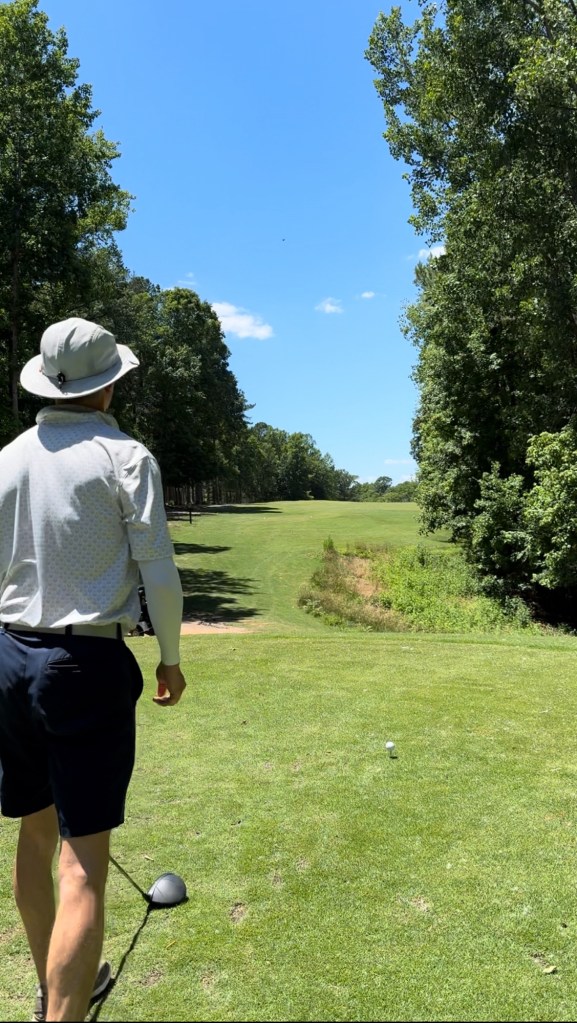
For my routine, I use a combination of visualization and counting. I do my very best to clearly visualize the shot I want to make. And I am amazed regularly when I truly commit to how the shot should “look” that my result matches what I visualized – more on visualization in a future blog.
The counting part does a couple of things: first, it keeps me on a clock and reduces the opportunity to second guess my visualization of the shot. Second, it also gives my conscious mind a task that I have to stay “present” to complete – meaning I truly can’t count on “auto-pilot.”
And although this process sounds/seems simple – developing the mental muscle to truly commit and execute this process on every golf shot is AS difficult as golf itself.
In my three winning rounds in 2023 and in other instances where I have played “out of my mind” putting it all together is rare – frustratingly rare. It can not be overstated that developing a strong process in your golf game takes time, tinkering and practice, and then more practice.
Everyone’s process is different. Just like everyone’s brain is a little different. So you really have to determine how best you can compile your process. I use counting because I know my brain struggles with numbers. I also rely on visualization because I daydream a lot – I have vivid dreams – so I can stand on a tee and “see” the flight of the ball. I can imagine it. The more I practice this process, the better my results.
And to the contrary, when I am tired, frustrated, hungry! 😂, angry, my capacity and patience to count and visualize are diminished and so to are my results. I become that overthinking driver, jamming on the brakes or swerving wildly around corners. I need a conversation or a song to get me back on auto-pilot. One…one-thousand…two…one-thousand…three…





Leave a Reply