
Somewhere back in the history of golf, a horrible habit was born. Somehow the ability to hit a round object multiple times and sink it into a hole in the ground became intrinsically tied to one’s intelligence, worth and/or value.
This habit has persisted and has been passed along into modern day amateur/social golfing. The things I have said to myself and called myself on the golf course are things I would never say to another person.
The things I have heard other golfers say about themselves or to themselves would easily start a bar brawl if said to another human.
Golf has the ability to pull from the golfer their biggest fears, embarrassments, and demons.
Why do we do this?
Much has been studied and written about the self-identity of an athlete. That’s a real thing and certainly plays a role in the habit I am talking about.
And to me, it’s not the same thing. I am talking about non-elite, amateur/weekend golfers who don’t see themselves as peers or even aspire to be like Rory or Woods. I am talking about golfers like me and those I have introduced to the game. I am talking about golfers like my family; my friends from college and folks I meet at the local golf charity tournament.
I see this behavior everywhere and as a true habit which is introduced the first time a person tries the game with more experienced golfers – friends, parents, co-workers.
The new golfer will hear the experienced golfers say something like:
“Ok, let’s see if I can keep this ball out of the pond over there.”
And of course, the shot bananas right and into the water hazard.
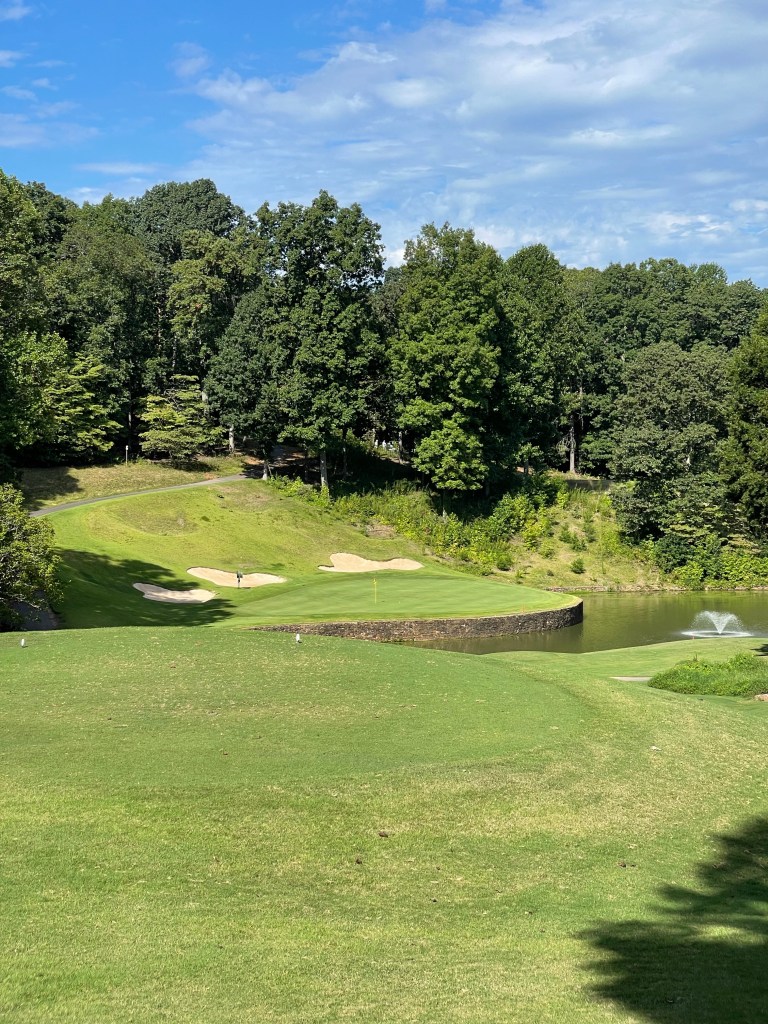
“Ugh! I am soooo stupid!” Says the experienced golfer.
(Note: usually the comments are much worse and I am keeping the language “clean” here for the younger audience.)
And the new golfer begins to learn through experience that negative talk and self-depreciation are part of fitting into the golf experience.
“Joe calls himself ‘stupid’ when he misses a putt, so if I miss, I should call myself stupid too.” And so the habit is formed and reinforced through each round where this kind of talk is present.
Another great example of this is when I meet another golfer who learns that I play amateur tournaments. Without fail this person will say “well, you don’t want to play with me because I am not any good.”
Whoa! First, I don’t care! And I mean that in the nicest and most non-judgmental way possible. How good a person is at golf (which I know to be ridiculously difficult) in no way informs whether I want to join you in a round of golf.
Non-competitive golf is meant to be just that – NON-competitive – social – F-U-N! I DON’T care if you hit your ball into the water! Big deal.
And yet, the reflex to apologize in golf is automatic and I believe tied to this horrible self-deprecating habit.
Here’s another example: I got paired up with a gentleman I had never met (let’s call him “Jim”) in the first round of a 2-day tournament. First thing he tells me about his game is “I haven’t played in 3 months.” This was his way (in his own mind) of “apologizing” for whatever bad golf was about to happen.
First hole, he nails his tee shot down the middle of the fairway; follows on with a beautiful approach shot leaving him an 8 foot birdie putt. He misses the birdie putt, and taps in for par…pretty great start.
I on the other hand, pulled my drive out of bounds, re-tee’d and hit a good recovery shot into the fairway. My next shot found the green, however I left myself with a 25 foot putt for bogey. Which came up short, and made the double bogey putt from about 6 feet.
We get back in the cart and I say “great par!” He responds “well, it won’t last…”
And it didn’t. He spent the next 17 holes berating himself each time he hit a bad shot – “Oh my G-d – I am the worst”; “You, idiot!”; “That was SO STUPID”.
Mid-way through the round Jim says this:
“Ya know, most people say that I am the most positive person they know. Especially at work – I am alway the one praising everyone, and encouraging them to do their best. But, when I get on a golf course, I just can’t seem to be positive to myself. I am my own worst enemy.”
BINGO JIM!
If I have learned ANYTHING in my golf journey it is exactly what Jim said – we are the “worst” to ourselves. I believe this is caused by a two-fold process:
One: it is a learned behavior/habit from other golfs. We want to fit in and if Jim is calling himself an “idiot” for missing the birdie putt – then I guess I need to do the same when I hit it out of bounds. So, I start that bad habit and pass it along to the next person…and so on.
Two: this habit opens Pandora’s box into our “self-critic”- that part of ourselves that just “can’t be happy.” “See, you are terrible at this game and you should just quit.” “Wow, nice shot into the woods! You should be embarrassed! Better yet, just stop…no one wants to watch you play bad golf!”
And the cycle swirls and it really gets in the way, if you are trying to get better at the game. I believe the “average” golfer – someone who wants to improve their game to have more fun – would lower their score 3 to 5 shots a round if they just learned to think and reinforce themselves in a positive manner.
It would also begin to remove this nasty habit that we (experienced golfers) pass along to those who are new to the game.
How do we close Pandora’s Box?
First, like all behavioral change, we must recognize and acknowledge that we do the very thing we DON’T want to do. Next time you are on the course, listen to others and yourself and begin to catch when negative talk happens. When someone else says something self deprecating, you say to yourself – “not listening”. Eventually, by recognizing and then reacting by “not listening” you will begin to tune out the negative talk around you.
Second, (and I learned this from Coach David Jones) “tell yourself what you WANT to have happen – not want you DON’T want to have happen.” According to Coach Jones: “Our brains do not recognize the “don’t” in the command.”
For example: You are standing on a tee box and all along the right side of the fairway is Out of Bounds. The average golfer will say to others and themselves “DON’T hit it right…that’s out of bounds.” And guess what happens…someone will hit it right.
Instead, in the same scenario, tell yourself: “Hit the ball on the left side of the fairway.”
Not only are you telling yourself what to do – you are telling yourself the positive outcome you are wanting.
Third, learn this phrase… “I don’t care.” I want you to say it out loud while you are reading this… “I don’t care.” Seriously, out loud: “I don’t care.” Next time you hit a bad shot – which we ALL do BTW; I hit bad shots all the time – say out loud to yourself “I DON’T CARE.” Miss a 3 foot birdie putt: I DON’T CARE. Chunk your approach shot into the water on a par 3…what do you say? I. DON’T. CARE.
Here’s what this will do for your game:
First, by not caring about the outcome, you are removing the value your self-critic will stab you with…that voice is powerless if you don’t care. (And you shouldn’t, it’s just a game where you are trying to hit a ball in a hole – no one is losing their livelihood, or their life over it. Missing a three foot birdie putt is…wait for it…just NOT that big of a deal in life…period.)
Second, by learning to not care – you can remain calm and relaxed for your next shot or making the next putt. (How many times have you or I been so pissed off by what just happened that we make another bad shot/putt…guilty!)
Lastly, there’s a saying that applies here “fake it till you make it.” Changing behavior is HARD…probably as hard as golf itself. So it’s not going to be change that will be evident right way. (I am on year two of my behavioral change and yes, I slip up and get super pissed from time to time and I reset and go back to the process…I Don’t Care. Play the next shot.)
The social pressure to actually be “positive” on the golf course is pretty daunting. And “haters gonna hate” – there will be people you play with (intentionally or not) that just like to be awful and say awful things out loud “hey if I can’t drink beer and be crass on the golf course, then where else can I.”
BLAH.
“I am not listening.”
“I don’t care.”






 English Major Golfer
Leave a reply to TEDx and Dog Food – English Major Golfer Cancel reply